The Death of Purpose in an AI World
For over a century, we’ve confused a job title with real purpose, trading our intelligence on an earn-to-consume treadmill. Now, AI is collapsing the cost of cognitive labour while a debt-loaded GDP model stalls. Here is how to detach your identity from your paycheque, ditch narrow specialisation, and build genuine human resilience.
The Death of Purpose in an AI World
The wake-up you didn't ask for.
I'm sure you feel it already. A gnawing in the pit of your stomach. A tightening of your chest when you breathe. You're feeling fatigued due to your constant state of anxiety. The world we've become so comfortable in is changing fast, and the rules we've lived by no longer seem right. The old 'work hard, get ahead' rule for a good life had stopped working. The staggering pace of change is leaving us breathless as we struggle to control our lives in this madness we call modern life.
All the science fiction buffs are rubbing their little paws together as we're told that we may become slaves to some tech overlord. The media is flooded with a wide range of dystopian and utopian opinions, causing us to feel lost in ignorance and anger at being woken up from our couch of comfort. Is it time for the blue pill vs. the red pill test already? This is not a technical guide about robots and AI agents, but a survival guide for the human spirit. The next few years are not about software, but about our obsolescence from a well-worn path of success and independence we've been groomed to be a part of.
We were lied to and sold a script we believed would empower us, but it turned out to be used to enrich an elite class. A few long-term thinking globalists who created the game about a hundred years ago, mastered it, and still control it today. They are the house, and the house always wins. They've engineered a standard linear system for us of schooling, a degree or trade, a job, a partner, children, a house, and then they put us out to our pasture of retirement. This has all been working wonderfully, well, on the surface anyway. Let's look back for a minute to see what's changed. First, we lost our physical labour to the machines (agricultural and industrial), leaving just our intelligence, which we poured into tech and services. Now that the script is being rewritten by an alien intelligence we've created that can do everything in seconds.
I spent a long time thinking about whether AI would be good or bad for us, and realised it's a futile exercise because no one really has a clue, not even those developing it. We've had chatbots taught on company sites for a while, but the large language models (LLMs) were like someone pressing the accelerator to the floor. We're not talking about a drastic change to our world in the next decade, but rather in a couple of years. The timeline has just been compressed by the scarily rapid development of the next disruptor.
One of the major risks everyone agrees on is that, for the first time in the Modern Era (since 1900), it's not just factory workers who'll be at risk, but also lawyers, accountants, coders, writers, middle managers, and others. All those "safe" jobs where people spend so much of their daily tasks on a screen of some sort.
Real purpose is been stolen by a system that values us only for our economic output, or by our GDP economic model that measures our growth rather than happiness. But, while the economic value of the human will inevitably drop, other opportunities will open up as our intrinsic values grow and mature.
What does purpose mean to us? And why we need a new one
For the sake of this article, I won't delve into the depths of philosophy and psychology to come up with an academic definition of what our purpose is in life on this planet. It would simply take too long.
When you wake up each and every morning and place your feet on the ground, you have a purpose to your life, and for a vast majority of adults, that is a job or your own business. For many people, having a job gives them meaning. It's the reasons so many people get up in the morning, get dressed and make the tedious pilgrimage to the office, or to the downstairs office if you work from home. For over a hundred years, we've been groomed to work for our survival. Our needs, according to Maslow's hierarchy, can only be met if we honour the daily slog in return for money to buy the things we need to survive. So, at its base level, our purpose is to work in order to survive.
Sure, some people are totally fulfilled in their everyday job, and I'm not saying that many of us don't love what we do, it's just that our need to survive is tied to what we earn. It's not known as the earn-to-consume treadmill for nothing.
If you disagree, just have a look at the next time you're in a large gathering, e.g., a networking event, a work gathering, or a large social event. When you meet someone new, notice how long it takes before one of you asks the other what you do for a living. We're defined by the job we hold, and we have long confused employment with purpose. We thought our purpose was to be an accountant or a driver, but those are just functions in our world, not purposes.
Think about it. When our external validation, like praise from your boss, your paycheck or your fancy job title, is gone, you will be left staring into a void. In that void, you will have to confront your inner truths about yourself, and that's where many will find fear, darkness, anxiety, depression, apathy, and solace in addictive behaviours.
We've been told our whole lives that our job is our identity, our purpose and our value. So, when we hear about automation and AI, it feels like a personal threat. But what if we've been looking at this all wrong? What if this isn't a threat to our identity, but an invitation to finally discover it?
For 99% of human history, our purpose has been about survival and about embracing and relying on our community. Only recently did it become about individualism, career advancement and corporate ambition. With the advent of something that can do so many of the menial repetitive tasks we do, maybe we're reverting to past values a little, which will push us to prioritise community.
Among the several very knowledgeable AI experts I follow, I regularly hear them agree that the one job that will remain largely untouched is entrepreneurship. Ask yourself what AI can't do in relation to being a human. It can't feel pain, it can't love, it can't feel the thrill of a sunset in a distant land, it can't feel the love of playing with your children or pets. It can't feel the joy and loyalty of friends sitting around the fire, discussing mundane things. That is where our purpose should and hopefully will be reborn. By shifting our world toward the experience of real connection, we can slowly rediscover humanity's purpose.
We will find joy and meaning in serving others as we move from production to people. Care work, community, art, philosophy, and raising balanced children. All things that don't add to GDP but certainly add to the quality of life.
Here is a little exercise for you to ponder. It's called the Eulogy Exercise. If you died today, nobody could list your resume or the companies you created. They would, however, be able to talk about how you made them feel. What are those feelings or deeds that led to those feelings? Explore that and know that is where you'll find your real purpose.
I certainly hope it proves to be true that the age-old question of "what do you do for a living?" will be replaced by "what are you living for?"
Just how good is AI really
I remember the first time I went to a banking site, and a small chat box popped up in the lower-right corner. I started a conversation about the issue I was having, and soon realised I wasn't talking to a human. I was talking to something trained to analyse my question and suggest solutions it could find on their website.
As I write this, we seem to be in a cross between a massive tech bubble (once again) and an AI arms race. Trillions of dollars are being pumped into models and architecture to drive the one eventual winner who can raise the AGI trophy. The biggest fly in the current ointment is energy and gargantuan amounts that it's going to take to scale it for our needs. I don't believe it will stop the juggernaut, though, as nuclear and AI itself (once it's pointed to reinvent physics) will solve that bottleneck.
As everyday men and women struggling on our awesome journeys, this all seems so distant, so let's look a little closer to home. People need to stop seeing AI as a tool like a hammer, a bicycle, or an Excel spreadsheet. We need to start seeing it as an alien intelligence that has read every book, knows the whole internet, can pass every exam and never sleeps. You have access to it on your smartphone now, so start thinking of it as your own PhD student who knows everything but doesn't have much experience living in your world. Talk to AI as if it were a person, and your results will be way better than if you continue to use it as an advanced Google question box in the middle of that iconic white screen.
AI is here, and there is no getting that genie back in the lamp. The likes of Mo Gawdat and others agree that its power doubles every 5.5 months, and that number is getting shorter. While this is both exciting and terrifying, this growth must be placed into context that its foundation is being laid in an energy-scarce world, built on the back of the global economy that is being crushed under debt (235% debt to GDP ratio), so all this could stall or end when we have a predictable cyclical or inevitable economic collapse.
Be that as it may, it's still incredible what AI is currently capable of, and it's only beginning. Creating awesome text-to-video and other great creative advances really challenges our thinking that we alone are arty, creative, empathetic, and oh-so-clever. AI can now write poetry, diagnose diseases, and pass the medical and Bar exams better than most who attempt them. All of this is bringing down the cost of intelligence, which is plummeting to zero, and that's a real problem for us.
For the longest time, humans had both muscular and intellectual power to hold sway over other species in our world. Slowly, we lost muscular advantage as we used livestock to plough the fields, then, with the Industrial Revolution, we lost muscle ascendency on the farms, and all had to scurry to factory jobs or work in shops. Mass manufacturing (production lines) ramped up, and automation took away our muscular power altogether. All we were left with was our intelligence.
This allowed us to perfect the journey from creating the humble resistor to inventing the PC and the internet to enhance our intelligence. We built billion-dollar and trillion-dollar software and service industries around intelligence and marvelled at the world we had created. We stood back and revelled in our own magnificence as we invented an alien intelligence on Earth that will lower the cost we can charge for our intelligence. Bloody genius.
Going forward, why would you hire anyone starting out on their journey for $50k when a software product can do the same for $20 per month, works 24/7 and won't need a pension or demanding vacation days?
Now, there are some issues that many sceptics will point to, the most common one being "but it makes mistakes." This is, of course, pointing to the hallucination concept that we've all seen. Humans also make many mistakes, but AI learns from its mistakes much faster and never repeats them.
AI is here, it's smarter than us already and getting even smarter with every iteration. How it all turns out, or where the journey goes, is the subject of discussion among every expert and podcaster. Here's a little tip. No one really knows anything about it. It's just hope and speculation. We're a bit like Dr Frankenstein here. We surprised the crap out of ourselves by getting the technical process right, and we have just seen the monster twitching into life for the first time. Anything goes at this point.
The Traditional Social Treadmill is done
A career path. The social construct. The checklist. The cradle-to-grave path. A normal life. Settling down. The rat race. Keeping up with the Joneses. The corporate ladder. Having it all. The American dream, or The dream. The perfect life.
It's all part of the magnificent lie we've all been sold since the early 1900s. Our schooling is steeped in its Prussian origins, which were invented to create workers for the factories and soldiers for war. It required a system to build a compliant citizenry that would live a prescribed life and not question authority, so they devised a school system to create a funnel for responsible citizens. The West copied that system, and it's very clearly still in use today.
It was a system that turned us from creative toddlers into hyper-focused teenagers aiming for a single career. We were taught to narrow our focus. Pick a major. Pick a niche. Specialise in something, then tell yourself it's what you want to do for the rest of your life. This treadmill has allowed a continuous feed of workers into a GDP model that requires an endless supply to continue achieving the growth it's addicted to. It was part of the old paradigm where being a specialist was safe and secure. In the new AI world, this thinking will be suicide for a career.
In schools today, we grade kids on memory recall (which AI does perfectly) and punish them for daydreaming or questioning (which AI can't do yet). We're educating the humanity out of all humans so they can function on a predesigned path. It's basically a factory-production-line education that is coming to an end as our world changes. Even without the probable disruptive power of AI, economic storms are brewing. The continual expectation that all 18-year-olds must go into crippling debt for a degree that may not exist in its current form is crazy, and so, the feeder system has started to stall and fail.
We're turning out millions of students globally each year with a piece of paper and a debt, as we try to funnel them into their promised checklist life. They stand there all excited, looking up at the first rung on the ladder and realise that the perfect life that they were promised won't happen. Their piece of paper used to be the gatekeeper for a good life, but that is all changing fast, as actual skills and adaptability matter more than credentials.
AI and Agentics skills will matter more than your ability to pack your CV with a list of jobs and experience. The career path is under threat, not because it will disappear, but because it will eventually be compressed. Odds are you won't have one career, but will need to pivot every five or so years into something else. As I said, being a resilient entrepreneur will be one of the greatest skills you can acquire.
The feeder systems (education) will change as their students have nowhere to go. Younger generations are already behind their parents and grandparents on their life journey when it comes to the treadmill and are starting to opt out, or, worse, develop deep resentments toward the very things that created the world they were born into. Dan Koe uses a fantastic phrase that I'll repeat here. We've been living a "Conditioned Human Experience", and it is ending. A new world will eventually evolve, but we need first to make it through the collapse of the old one, and I think AI may be the catalyst for that collapse, as the powers that have been propping up the old one run out of levers to pull to save it.
So how do you make it through all this? Start embracing what we are as a natural species. We are naturally curious polymaths who can be really good at multiple things. School beat this out of us to make us "employable" for the system. Going forward, the generalist, or someone who can connect the dots across multiple fields, will be the only ones who can make a success of their lives in a world that may have two types of people, creators vs consumers.
Start your journey by trying to think in terms of unschooling yourself from what you were groomed to be. Become curious about learning new things again, and then restart your education, no matter your age. Most of us cannot remember being 5 years old, but we were generalist geniuses with unlimited curiosity and adaptability (all schooled out of us). The most important character trait you'll need to cultivate is a willingness to strive for failure. It's in struggle and failure that we all grow. Question everything and everyone, and develop a healthy contrarian mentality, which will help you develop critical thinking and, most importantly, in a world of infinite intelligence and technological leverage, your most important life skill: judgment.
The Push Back from the "Traditional World"
No change of this magnitude in our world will happen without pushback from those who fear the future and worship at the altar of safety, comfort and greed. It's perfectly natural. They hold the levers for keeping the economy safe and the money flowing upwards. Why would they vote for the death of the goose that keeps laying all the golden debt?
AI is a major disruptor now, and it will affect all professions. Drivers, professors, authors, lawyers, accountants, regulators, and doctors are a few examples of people who are heavily invested in or trapped in their industries. They will resist the notion that AI will automate most, if not everything, they do, and will look to governments to protect them. Their whole world has been a linear path of knowledge accumulation, which has made it ever more marketable on their CV, but they haven't grasped (or refuse to) that it's that exact knowledge that AI will provide for free to their employers going forward
The problem is people believe AI won't take the jobs I've listed above. I understand this, but while it won't take all jobs at the same time, gradual inroads will be made into all industries. At the rate of the doubling of AI power every few months, and the direction of travel of this race to get AGI or superintelligence, the inevitable consequence will be that anything we repeatedly do on a screen will be automated.
Just look at what disruption things like Uber brought to the taxi industry, and Airbnb to the holiday letting industry. Massive shake-up as control was wrestled from traditional internet-based models, pushing power into the hands of the driver or bed-and-breakfast owner. Let's just take drivers around the world, for instance. One of the most popular professions, with more active members than many other careers. Uber partnered with many to become self-employed and take control of their lives. They bought into the dream, only to now be threatened by AI-controlled, driverless vehicles we already see making headway into the industry. Where do these men and women go now? What can they cross-train into? Trucks and delivery drivers are next, with the only roadblocks being capital outlay and regulatory hurdles. It's not so much the job revolution, but the rate of change and the massive number of people who will need to move across industries en masse.
Politicians will continue to harp on about what they promised when they were elected, promising to create and protect jobs, push economic growth, and ensure people's welfare. CEOs will continue to talk about reskilling and job augmentation as they secretly watch their labour bill go down, and their profit go up with glee. They will echo politicians who parade notions that "AI will create jobs", failing to grasp that while it will indeed create new skillset requirements, the sheer mass of humans having to switch careers will never be satisfied. Don't get me wrong, I don't believe for a minute that AI will replace everyone in one disastrous Black Swan event. Things will continue for a while as companies chase the hype and issue instructions to "add AI to everything", resulting in a whole new market for $30 per month products that no employee will ever use, but the shareholders will be proud to invest in as an AI-ready company, which it won't be.
Many correctly point out that AI is an expanding bubble at the moment, and they're right in some instances to compare it to the Dot-com era, a time I remember so well. Money flowed into companies that offered little value compared with the capital flooding in. Families and small businesses invested heavily as the mania increased month by month. There seems to be no end to the market's rise. Hindsight is clear that some were right to warn about the disastrous crash that wiped so much value off companies and left individuals broke and homeless. In the end, most dotcom companies went bust, many individuals sadly lost their shirts, and the market bottomed for a while. But let's not forget that, out of all that chaos, came the foundations of the e-commerce and digital revolutions, as well as major companies (Mag7) that top the S&P 500 today.
We see words like 'bubble' and 'mania' used all over the place now as people point to the ridiculous valuations of chip manufacturers, which have pushed markets to all-time highs. It does look like a bubble, which will pop, but that's not the point here. The growth of the underlying architecture and models matter, as they will outlast market or price fluctuations and continue to push technology forward. Now, as someone who dabbles in trading, would I touch these high-flying stocks? Not a chance, and not just for the price, but because I cannot see how many will get a return on their investment, not when so much of the technology is and has been open-sourced since day one. That part of the future remains anyone's guess.
The natural reaction from our leaders and global institutions will be to try to control AI and the companies that are making all the strides. When they fail, as they will, they'll try to outlaw, or at least tax the hell out of it, while trying to slow it down a little as the declining economies and job losses make it impossible for anyone to get re-elected.
The death of the economic model we have had for decades.
When I became a self-taught student of macro environment, energy and economics almost thirty years ago, I had already been a wildlife photographer and environmental activist for twenty years. I joined an energy company to work on IT projects and got hooked on the need to explore alternative energy sources. Then the 2008 financial crisis hit, and I was studying its effects on the environment and energy sectors. It was then that I realised that nothing else matters more to our GDP model than energy. Energy from the ground and energy of humans toiling for a salary.
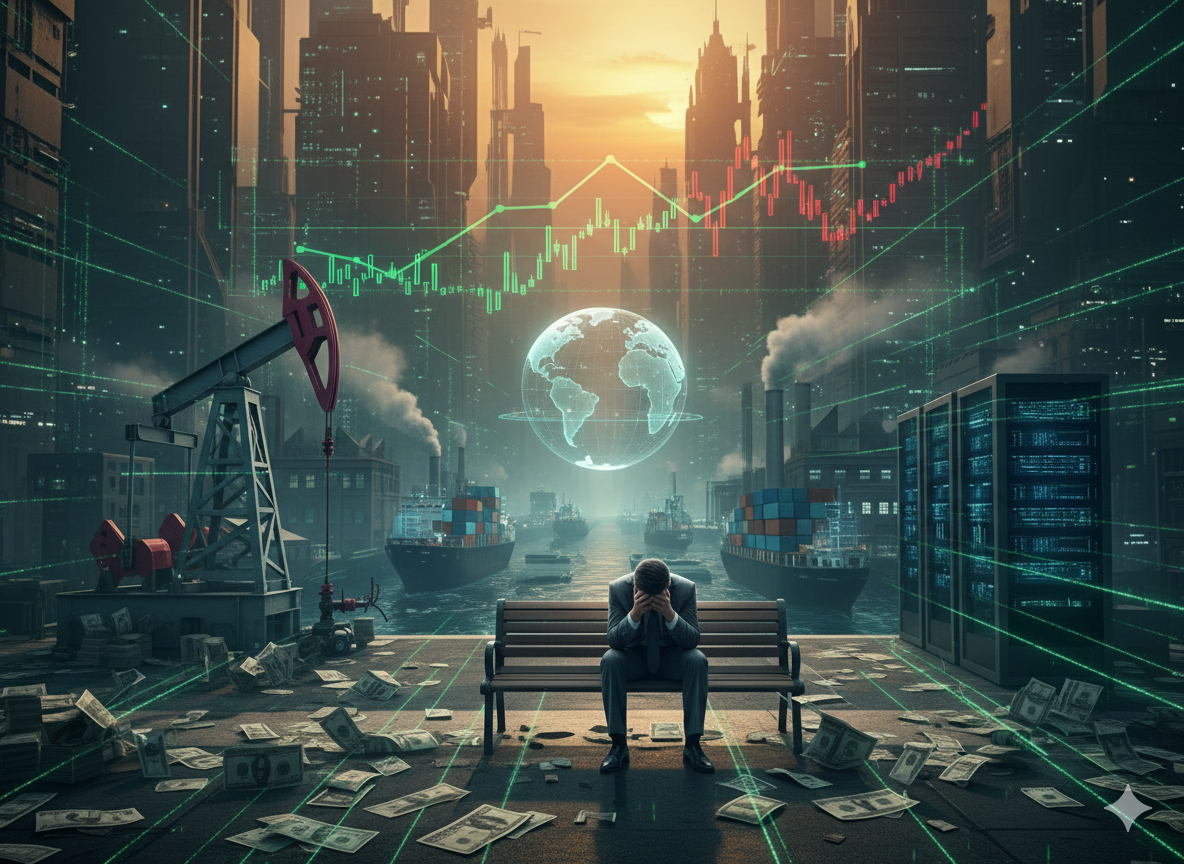
With those three arrows in my quiver, I look at the world through three lenses and set those against the patterns and cycles of our history. All civilisations end. The first sign is that our monetary system and GDP economic model have exploded to levels never imagined. It is a Ponzi scheme that is about to end because the next generation entering the workforce simply won't turn out to prop it up as previous generations did.
Simon Kuznets developed the Gross Domestic Product measurement in 1934, and it became the global standard at the Bretton Woods Conference in the 1940s. Kuznets spent many years after that warning us against using it because it doesn't account for a country's happiness and welfare. Sadly, it was accepted without question and has been used as the primary measure of economic well-being worldwide. Over the years, amid layers of laws and regulations, it became entrenched, with no appetite for questioning the "one and only" measurement to account for a nation's wealth. The problem is not that we measure GDP; it's that it has become the de facto standard for national well-being, failing to consider other relevant factors, like the welfare and happiness of the people.
So, with this model as a driver of monetary and fiscal control and reporting, we became addicted to constant, endless growth. We're now caught in a growth trap because of all the debt interest. The major countries are now struggling to pay the interest, let alone the principal loan amount, and continue to borrow more because they keep promising more to voters. This demands a constant-growth economy with infinite jobs, more free stuff, more consumption, all just to stay in the same place.
Here's a simple explanation I found somewhere on the web: Modern GDP = debt growth + population growth + productivity growth. I'm sure economists would argue about that late into the night, which they are entitled to. I like it in its oversimplified manner to help everyday people understand why the monetary system and economies are stalling at the cliff edge.
Once you understand that Fiat currency is just a paper promise (loaned into existence), your worldview starts to change. The system requires debt to exist and function. If everyone paid off their debts tomorrow, the money supply would seize up or vanish. All our accumulated paper wealth would evaporate.
As AI takes over so much of our corporate services and manufacturing activities, jobs will not be saved, no matter what your politician says. More and more people will be stuck in a downward spiral to bankruptcy. We've been educated and groomed to jump onto the social treadmill that demands we earn money and consume stuff straight away. So, if robots manufacture every aspect of our smartphones, but nobody has the money (no job) to buy the iPhones, the GDP model collapses. We're moving from a world where scarcity of labour created value in the system, and now face a world where labour is infinite and cheap. Prices of services and goods will crash, but wages will crash too. My hope is that as AI lowers the cost of living, as prices for goods and services lower, we'll need less money to live as expenses decline
The current system, thanks to its gatekeepers, will fight this reality, likely pulling the same levers that exacerbate the problem, namely, the inflation and money manipulation levers. This digital printing of money (borrowing) to solve today's problems is effectively stealing purchasing power from our future selves and our children. It's a generational credit card that's maxed out.
The seventy years of cheap money and endless wealth-driven opportunities seem to be coming to an end as the whole house of cards that relied on human labour and intelligence begins to tumble.
While many see AI development as similar to a typical arms race, I believe the real threat lies in the fact that it's heavily geared toward replacing our collapsing economic model with a similar one that centralises all the power to a few people.
I think these are two of the most likely scenarios facing us in the AI world: Digital feudalism: This is the future we will face if we change nothing at all in our current race for AGI. There will be a handful of global super-companies that will amass vast amounts of data, data compute, energy, and so on, and control everything. We're a digital species now, and the hard-working people in this world, not much will change. As Emad Mustaque says in his book The Last Economy, "Everyone lives on UBI, enough to survive, not enough to matter. You are a user, but not a creator. You are a consumer, not a citizen." I think this is our direction of travel unless we can democratise the race a little more.
Nation-state protectionism: This is a fragmentation when all the nation-states (countries or alliances) we live in start to panic about being left behind. They start pouring state funds into the development and rollout of their own AI, using it for protection and localised control. They guard their own models, data and infrastructure and trust no one else's. It's already happening as the fear of being left behind, and therefore possibly being controlled by someone else, hits the local echelons of power. AI protectionism results.
As I've highlighted throughout, we're in the Modern Era (1900-present), the crowning glory of our civilisation, all built on cheap energy and money. You'd have to live in a cave not to see the chaos escalating, as civil wars of some sort around the globe seem to be inevitable.
The foundation of consumerism upon which our world is built is under threat as our economies seize up and splutter with debt, job losses and recessionary threats. Now, AI is ramping up as the heavyweight in the corner, about to start a fight with an opponent that is already bleeding and has fought several fights already. The system created all those years ago at Bretton Woods is now on its knees and is being counted out. There is not much fight left, or levers left to pull to stop it from being overrun by the fresh disruptor.
What can you, the individual, do? Well, learn about the history of money and how we came to be a debt-driven economy. Learn how money is created and who takes their share at every step. Learn about diversifying your assets. Delve into macro cycles that have happened over the past two hundred years. Understand that being an entrepreneur from as early as possible will make you battle-hardened and experienced in creating and selling. If you are already one, start a few other small businesses or revenue streams, focusing on the "human connections business," where empathy and physical connection are vital.
If you're in a nine-to-five job, start learning to detach your self-worth from economic utility. You are not your paycheck, so start diversifying your skills to help build emotional and economic versatility and resilience (get the skill regardless of whether you can make money on it right now). Losing your job is not the end of the world if you have other skills that you can slot into until you find your feet again.
The Nirvana Life?
Nothing about this offers any certainty, and so those who depend on governments and institutions to provide their certainty and assurance are really going to suffer. As we slip further into a new digital world, many possible outcomes could become our reality, at both the economic and global levels, and so affect our daily lives. Rapid change is the only certainty that I believe is guaranteed, and that the powers that be will try the same tricks and pull the same levers as before. At some point, these will stop working, or they'll be too far gone to implement anything meaningful.
Currently, we're staring at some kind of digital feudalism as economic power rests with fewer and fewer institutions and global companies. Eventually, the AI companies will transcend governments, whose failure to help us individually will result in their demise and cause national chaos. Whatever future does come to pass, and it may be some hybrid of what we have now, we humans will not have a prosperous one, with opportunity disappearing.
Does that mean we just sit around and do nothing? Not at all. As we've seen many times before, knowledge is power. Knowing that things are about to change dramatically is a powerful advantage. Positioning yourself in diverse ways, economically and skill-wise, will help. The knowledge that wealth will continue to be printed away and that some skills may become redundant is a resilience skill that everyone needs to develop. Predictions in this AI arena are so varied because we're dealing with an "alien intelligence" versus an unpredictable emotional species. Both sides will experience change, and this can alter the dynamics of our future relationship.
Whoever you ask, it is clear that some form of UBI (Universal Basic Income) will have to be provided to the population, either by what remains of governments, the globalist cabal, or by AI itself through fees collected on agentic transactions between AI and its processes. We may become a world where we are fed UBI to keep us quiet and compliant. A future of consumption where we exist with our VR headsets on, consuming content generated by AI, staying obese and becoming intellectually dead.
It's a harsh possibility to get your head around when millions of people are no longer needed to produce goods or services. All constructed purpose will disappear, leaving many lost and without direction. Our economy doesn't have a mechanism to handle these massive job losses, so it's likely we'll have an "underclass" of people who've had their identity and purpose in working for a living removed. We could face a psychological crash worse than any financial one before. This is not about me being a doommonger as I have a healthy wonder and expectation in the human ability to hope, change and survive. We are a special species that has got lost in comfort, but our hard-wired instincts to survive are not dead, just dormant. I want you to wake the hell up because the probability of what I've mentioned in the article happening is way higher than the probability of it not coming to pass.
There are many AI experts who will push the narrative that it will allow us all to be more creative and live a fuller life based on personal growth, and I certainly hope that is the case, although as someone who has been a "creative" since school there are many people who just won't make the transition because the don't believe they are a creator of things. They've been groomed through the education systems to focus on one thing, and eradicating all that indoctrination will be no easy task. I think that the danger of AI has nothing to do with robots killing us, but more likely, along with UBI, we will be pampered into irrelevance as we lose the ability to do or think for ourselves.
My utopian viewpoint is of a world where work is optional, if it ever exists at all. We would live in a place where AI has solved cancer and other ailments, increased our life span, solved all our energy needs, and where we are free to explore, create, and learn, but more importantly, become communities about connection, not of profiting from one another. I think it's possible, but I am convinced that to get to that awesome place, we'll need five to ten years of dystopia first. As an evolved species, we need struggle and challenges to grow, and a life of pure ease has led to stagnation, laziness, and inner turmoil for many who are not self-starters and need to be told what to do. We'll have to invent our own challenges in our hobbies, fitness journeys and learning if we no longer have work to provide them.
The gap between these two worlds isn't technological, but one of human mindset. The gap between the dystopian and utopian will only narrow for those who can be creators and have a growth mindset.
I haven't spoken much about governments and elite institutions because much will depend on the economy and energy as to what happens to governing powers. They will, of course, try to cling to power as they have in all crises before, and in doing so, won't make the changes necessary to pivot and survive. I have a feeling they'll go hard on population control, with mass surveillance, digital IDs, and typical credit scores to qualify for UBI. They'll believe all this is needed to manage the ever-growing "useless class". People could become consuming serfs to the AI powers who give them just enough to survive, and not enough to matter or rise up.
We're an incredible species that has grown and survived all sorts of challenges as we've evolved as Homo Sapiens. This will not change. I believe that humans will survive what seems to be a massive shake-up to our species' timeline. What excites me is that if it all pans out as I've stated, we will see a return to small communities and people focused on their own and their loved ones' timelines. We'll see people return to forgetting about all the small problems on the other side of the world because they genuinely can't do anything about them. The macro picture of the world will become less important as people build micro-utopias in their communities.
The rise of the Resilient Human
There are way too many variables to garner a clear picture of what will happen over the course of the next five years. The most important takeaway for everyone on the planet is to understand that the old "normal" days are gone. The world you were born into is gone. The treadmill is creaking and looks like it's seizing up, so it will stop funnelling people into the broken system. The old social contract is null and void now, as new generations can already see they will never be as well off as their parents and grandparents.
Becoming a resilient person is one way to build yourself in a world that is not going to look after you as it does now, whatever that means to you as an individual. It may seem terrifying, but you can look at the liberation it may bring as you are freed from the earn-to-consume treadmill. It will only happen if you start acting and pivoting now, and it's safe to say the vast majority of people will do nothing because they don't want to be woken from their safe slumber.
Set plans in motion to move away from the hyper-specialisation you were educated into or told to believe in, and start becoming a generalist. The winner of the future is the adaptable human who can develop their own agency rather than waiting for someone to rescue them. The one who learns fast, combines related skills, and possesses high emotional intelligence will continue to grow.
Resilience isn't just about being tough. It's about being a person who has developed the ability to bounce back and adapt to tough times. Someone who is not scared of failure and can learn to find their joy and opportunity in chaos. Think of it as rebuilding you and your close communities like an ark before the storm.
Is a short-term dystopia followed by an abundance utopia all we can hope for on a global level? Personally, I believe it's way more nuanced than that. The adoption of AI has been robust in some areas, such as coding and online design, but less so in others. People and companies have other, more pressing things in their world. Stock prices of the chipmakers are ludicrously overvalued, and with an economic crash, could slow development down to a crawl. Then again, governments may print currency just to back their nations' AI companies to win the race. The energy to continue the race for compute is more than we can generate with our current grids, and the small nuclear reactors (SMR) touted as the solution can take upwards of several years to plan and build. Maybe AI will, in the end, solve these problems for us, but that is more of a hope than a certainty right now.
The solution is to look inward, get your arse off the couch, and start learning again. About AI. About money. About systems. Find out for yourself what skills will be required if the AI revolution ends the current monetary system and civilisation in its current form. The future is harder to call than ever before, but I am optimistic that if you build your skill sets and your local community, you will be fine. Don't hope or plan for a better future. Peace of mind comes from developing the skills to handle multiple versions of your future, no matter what comes your way.
I wish you a glorious future, filled with peace and great beer