Men Over 50 in the Modern World: Time to Design Your Next Chapte
Hitting 50 isn't the beginning of a slow decline—it’s where you finally change gears. You’ve spent decades building and providing, only to find the old career playbook running dry. Here is a straight-talking, four-phase roadmap to build a future-focused identity, reclaim physical vitality through resistance training and sleep, and design your strongest chapter yet.

Men Over 50 in the Modern World: Time to Design Your Next Chapter
Time to Design Your Next Chapter
Right then, let's have a bit of straight talk about hitting midlife. So, you've clocked up half a century or maybe a few more years on top of that. It's been quite the journey, hasn't it? You've put in the work and seen the world change, and now, you're looking around, wondering what the hell comes next.
I still get shocked looking in the mirror sometimes, wondering where the eighteen-year-old I still feel inside disappeared to. It's a bit of a marvel, really. The sheer speed at which it all happened.
Growing up, I was one of those idiots looking at men in their fifties, swearing blind, I'd never be like that when I'm old.
Here I am in my mid-fifties, reflecting on all those damn clichés I probably used. Over the Hill. Set in his ways. Dinosaur. Midlife Crisis candidate. Past his prime. Grumpy old man.
When you see the long road behind you and the shorter one ahead, it's natural to want to take stock.
Did you stay true to yourself?
Did you achieve what you set out to?
Are YOU happy?
These aren't easy questions, but they surface around now.
Here's the crucial bit. I realised you mustn't fall for all that "over the hill" nonsense. This isn't about a decline. It's about you being able to change gears.
Think of it this way. You've spent decades building a house. Now, with more time, definitely more experience, and hopefully a bit more cash, you get to enjoy it. Maybe add that extension you always wanted for your man cave or hobby room. Kids flown the nest? Convert their rooms into that home pub or workshop. Or it could be time to sell up and chase a different kind of life in a new country.
This article is for you, the bloke who's got his hands dirty, built things and provided for others. It's about pausing and figuring out what you truly want now, and this next chapter genuinely can be your best one yet.
Time to Stop and Really Think
Everything changes from here, doesn't it? Our bodies don't bounce back at the same speed as they used to. You make noises getting off the sofa that could summon ancient spirits. Suddenly your arms aren't long enough to read the damn menu or your phone. Maybe the job that defined you for so long doesn't excite you anymore. You might feel lost and lacking in purpose.
I hit a wall like this after COVID. Years as a photographer, author, and business consultant... then, bang. Stuck. I just ran out of juice and felt my age for the first time. Being a Gen X raised in South Africa, my first instinct was to "walk it off" or tough it out.
It didn't work, of course. No amount of willpower shifted the funk. As men, we hate admitting we're struggling to anyone because it makes us feel weak. I get it. So, what's the answer?
First off, accept this isn't the end, but the start of the next phase. I love Victor Hugo's line on this. "Forty is the old age of youth: fifty is the youth of old age."
It's a second chance to build a different life on the back of a wealth of experience and better resources. I'm doing this right now by building new ventures.
Going through a process like this shook off the lethargy I felt and fired up the hunger again. Like everything worthwhile in life, it will take some time, effort and commitment, but it starts with defining a new identity for yourself -- one looking forward, not backwards.
Phase 1: Building a Future-Focused Identity
Our identity is built from many things: personality, career, and various roles we play. These layers accumulate over the years, often shaped by our upbringing and the path we followed. This isn't about fixing your past identity -- that would be a deep work project. You need to build a future-focused one.
Acknowledge the past wins and losses in a brief moment of nostalgia if you must. You cannot change it, so dwelling on it is pointless. Learn from it, and don't repeat the same mistakes. Keep moving forward. Your twenty-year-old self wasn't constantly navel-gazing about his failures as a ten-year-old. He was leaning hard into his future, full of dreams and ambitions. That's the mindset you need to recapture now.
Remember the old saying - you don't drive a car forward staring in the rearview mirror.
Decades of experience is now your secret sauce. Your twenty-year-old self had bags of energy but probably wasted a load of it stuffing around trying to impress people or figuring things out the hard way. You don't need that raw energy now because you have the skills to work smarter.
Middle age isn't a problem because it's a stage with its own advantages. Focus on the gains, the wisdom, the gratitude, not just the physical changes.
So, how do you build this forward-looking identity? Through action and vision.
- The Legacy Letter: Imagine you're 80 now, having lived an incredibly full and rich life. Write a letter back to your current self. What does that life look like at 80? What wisdom would you share? What made you feel truly alive? What steps did you take? What do you want to be remembered for?
- Ideal Day in Five Years: This is a visualisation exercise. Sit quietly and picture a perfect, typical day five years from now. Where are you? Who are you with? What are you doing? How do you feel? Much like programming a satnav, you need both your current location and your destination to be able to have a journey.
Think about the man you want to be, especially when times get tough. Being mentally and physically prepared is key to staying on course for your definition of an extraordinary life.
Phase 2: Developing an Empowered State: Mind and Body
You've envisioned a future self. Now, you need the right mental and physical state to pursue it.
Mental State.
Your mindset shapes how you see and interact with the world. Here are two key ones:
- Fixed Mindset: Believing your talents and intelligence are set and cannot change leads to phrases like "I'm not good at this," "I can't change," and "My best years are behind me." In this mindset, failure is seen as proof of limitation that will cause you embarrassment.
- Growth Mindset: Believing your abilities can be developed through effort and learning. Challenges are opportunities, and failure is a feedback system. (Dr. Carol Dweck's book Mindset is brilliant on this topic.)
Which camp do you fall into here? Be honest with yourself. I know that I want to keep pushing towards a growth mindset.
Life sometimes knocks us back and makes us wary of trying new things for fear of failure or looking foolish. Schools teach us that failure is wrong. But as we age, embracing failure as a stepping stone to mastery is crucial.
A key issue for men our age is losing that hunger or purpose in our lives. What's the point of trying?
It's often because we lack a compelling future to aim for and get excited about. Our brains are wired to spot threats and not to seek out happiness. Happiness is our responsibility -- we have to create it and seek it out through new experiences and challenges.
This ties in with Neuroplasticity, the brain's ability to adapt and rewire itself based on learning and experience at any age. Do some research into this to learn how awesome the brain is, no matter your age.
New activities = new neural pathways = better brain health.
Quick Exercise: Catch your fixed mindset thoughts like "I'm too old" or "I'll fail". Write them down. Then, write a growth mindset counter for them, such as "My experience gives me perspective" or "Failure is learning." Practice catching and reframing these thoughts daily. Don't beat yourself up if you have old thoughts; just gently correct course.
Physical State.
You can't stop ageing, but you can influence how you age. This means understanding about Lifespan versusHealthspan.
Lifespan is how long you live. Healthspan is how long you live well, free from debilitating chronic disease. The goal is to narrow the gap between the two.
Your non-negotiables:
- Sleep: Aim for 7-8 hours. It's fundamental for repair and brain reset.
- Hydration: Get your 2.5 litres in daily. Crucial for body function.
- Basic Nutrition: Forget fad diets. Focus on common sense Eating. Cut down on sugar and alcohol, eat real food (greens, healthy fats), and ditch processed crap where possible.
Now, the big one: Weight Training. Cardio is good for the heart and lungs, but resistance training offers way better long-term benefits for men over 50. It builds muscle mass (boosts metabolism, helps weight management), maintains bone density (critical), reduces stress, and improves blood pressure. If you're new to it, consider a personal trainer initially to get your form right. Going to a gym also gets you out of the house.
Yes, testosterone levels naturally decline, so do some research into its impacts on libido, muscle mass, bone density, mood, and energy. Don't panic, though, because lifestyle helps massively with boosting this: increased strength training, maintaining a healthy weight, good sleep, stress management, and a balanced diet (zinc, vitamin D). If your symptoms are severe, definitely see your doctor because there is no need to suffer in silence.
Phase 3: Shifting Your Patterns and Beliefs
Your mind is extremely powerful for affecting your life.
Dr. Joseph Murphy's book -- The Power of your Subconscious Mind highlights this. Your thoughts shape your reality every day. Our brain doesn't distinguish between 'good' or 'bad' instructions so feed it thoughts that propel you forward, not hold you back.
Limiting Beliefs are toxic. As I got older, mine felt more ingrained. Common ones were similar to "I'm too introverted," "I'm not good at this," "This is just how I am," "Why bother trying?" "Stick to what's safe."
We've all said some of them to ourselves. The trick is to catch and reframe them:
- "I'm not good at this... yet. What can I learn?"
- "This is how I am... but I can evolve. What small step can I take?"
- "Too old to learn... It's never too late; my experience is an advantage."
Ask a trusted person to gently point out when you use limiting language. It might sting, but it helps. Changing these beliefs lifts a huge weight off you.
Embrace failure as a chance to learn.
Believe in your value and experience. Repeat affirmations if it helps you. One of mine is: "This next chapter is going to be my best one ever."
Also, watch out for broader negative patterns - procrastination, resistance to change, dwelling on the past, social withdrawal, neglecting health, comparing yourself negatively, over-identifying with your career, routine adherence to the extreme, dismissing new ideas.
Pick one of these patterns that holds you back and actively work on doing the opposite for a few months. It will create significant shifts.
Phase 4: Crafting Your Action Plan
Right, you've got a forward-focusing identity with a growth mindset and a health plan. Now, let's build the roadmap.
- Define Your Horizon Goals: Dream big. Forget about constraints for a moment. If time and money were of no consequence, what would your ideal life look like in 5 or 10 years? What does future success mean to you right now? Picture that 80-year-old self again. These big, slightly distant goals are your "Horizon Goals." They keep you on track when daily life gets tough, and you're tempted to just look down at your feet to focus on the present. Look up, see the horizon, and correct your course. And, no, I'm not saying don't deal with issues in the present, just keep your focus (belief) on the future.
- Integrate and Broaden: Get your partner involved. Discuss and compare visions and find some common ground. Use the Wheel of Life concept (Google it) to ensure you're setting goals across key areas: Family/Friends, Romance, Personal Development, Fun, Contribution, Career/Business, Finances, and Health. You'll want to aim for balance across these areas.
- New Bucket List: Ditch any old lists you may have. Start afresh. What adventures, places, and skills excite you now? Think big at first, then pick one or two realistic ones to focus on in the short term.
Break It Down: Turn big dreams into smaller, actionable steps---monthly or weekly goals. If a short-term task doesn't align with your Horizon Goals, question why you're doing it. Start small at first. Want to get fitter? Start with a daily walk for a while, then join the gym.
Finally: Be Okay with Right Now -- Enjoy the Ride
Planning is vital, but don't live solely in the future. Find peace and enjoyment today. Accept the reality of ageing and the imperfections of life. Practice being present---notice the small things, the sounds, and the smells.
Sit in a park or coffee shop without your phone. Just breathe
Cultivate gratitude daily -- focus on what you have, not what's missing.
And most importantly, be kind to yourself. Talk to yourself like you would a mate going through a rough patch. Everyone messes up. Be gentle.
This next chapter isn't about passively waiting around. It's about actively designing what you want. As a coach, my role is not to do it for you but to teach you how to do it. You must do your own push-ups here.
You have the experience, the tools, and hopefully, the renewed hunger to make it a truly exceptional. It's your life -- go build the next stage the way you want it not what society expects you to want. This next chapter really can be your best one yet.
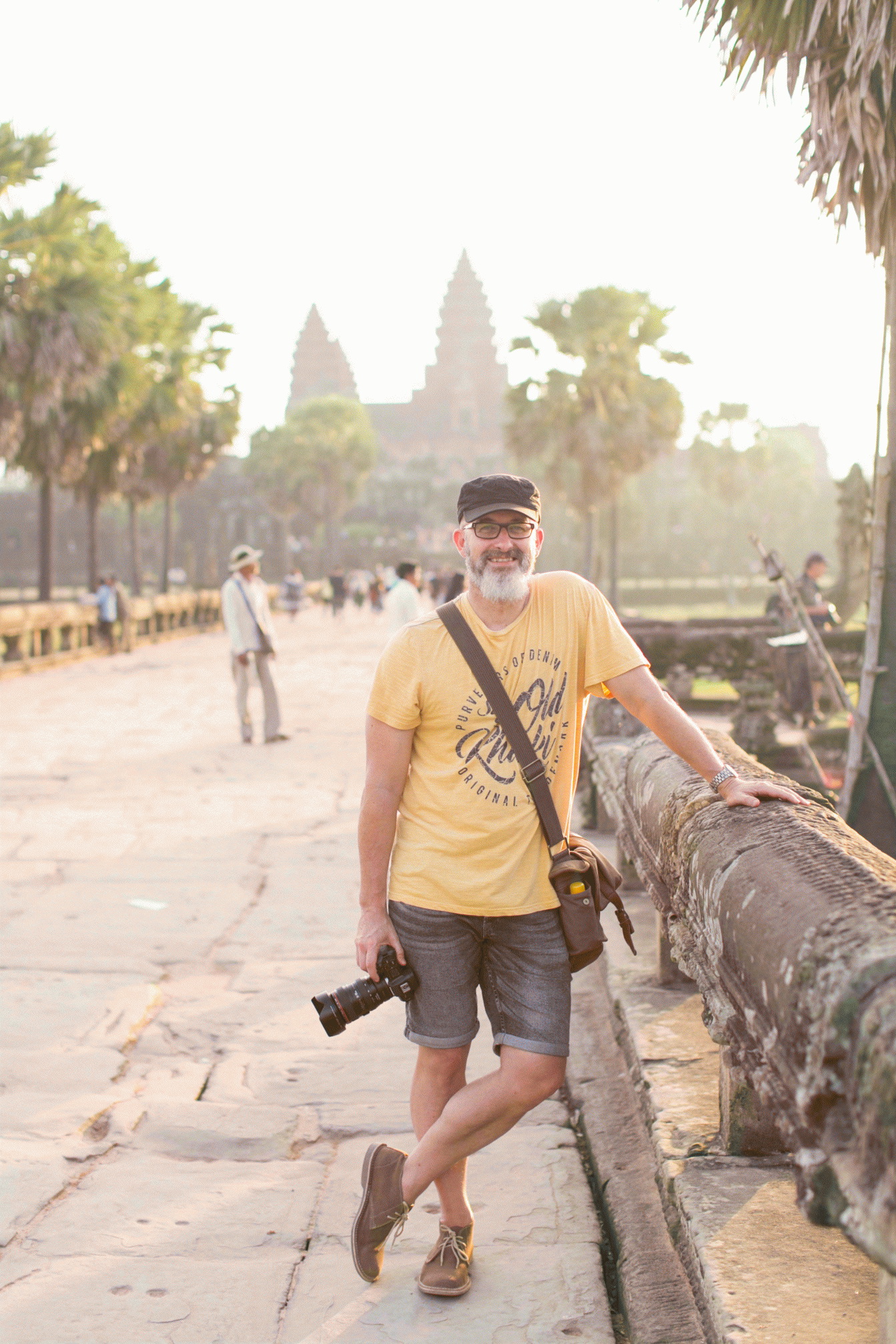
Author in Angkor Wat, Cambodia — 50th country visited on my 50th birthday